
A Warning to Students of Esoteric Philosophy
John Garrigues
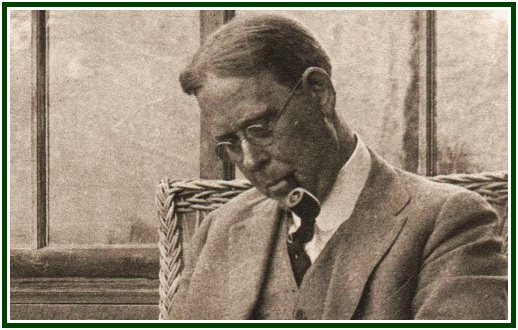
John Garrigues (1868-1944)
A 2015 Editorial Note:
The following text was first published anonymously
at “Theosophy” magazine, in December 1935, p. 96. An
examination of its contents and style indicates it was written by
Mr. Garrigues. Original title: The Tibetan ‘Book of the Dead’.
The book discussed by this short article purports to indicate
ways to avoid the Law of Karma. It is addressed to those who
do not have an interest in Ethics and would prefer to avoid the
consequences of their own actions, instead of learning from their
mistakes. Although the book commented by Garrigues invites its
readers to tread the disgraceful path of those who run away from the
Law, it is highly considered in pseudo-theosophical circles, and more
than one naïve student deceives himself into thinking it has some value.
(Carlos Cardoso Aveline)
Mr. W. Y. Evans-Wentz’s translation or rendition of the Tibetan counterpart of the Roman Catholic Ritual for the dead – perhaps that historic Christian Church’s antetype in more senses than one – is, like the Tantric books of India, a formulary of magical practices – and practices of black magic at that. [1]
A crop of follow-up books is increasing, all derived from one and another Oriental practitioner of “Yoga”. Theosophists should not confuse the “Tibetan” of Mr. Evans-Wentz’s title with the Tibetan so often spoken of by H.P. Blavatsky. His “Book of the Dead” is a ritual of “Red-Cap” [Ningma], not of “Yellow-Cap” magic. Nor should the book and its practices be confused with the Egyptian Book of the Dead – its exact antithesis.
That some such warning may be worth placing of record would seem to be indicated by the fact that so well-known a writer as M.A. Augustin Thierry in so well-known a publication as the Temps of Paris seems to have failed to grasp the basic nature of this ritual – as did Mr. Evans-Wentz himself, though the latter is, we believe, affiliated with one of the theosophical societies and should know better. [2]
NOTES:
[1] “The Tibetan Book of the Dead”, edited by W.Y. Evans-Wentz, Oxford University Press, London, Oxford, New York USA. First edition, 1927. First paperback edition, 1960, 250 pp. The book was enthusiastically publicized by Carl G. Jung, who cooperated with Nazism in Germany during the 1930s. The relation between Nazism and Tibetan Ningmas is relatively well-known. (CCA)
[2] In order to know more about the Ningma-pa and Dug-pa or “Red-Cap” character of the so-called “Tibetan Book of the Dead”, the reader is invited to see the article “Theosophy and the Bardo Thodol”. (CCA)
The above text was published by the associated websites on 28 August 2015.
In September 2016, after a careful analysis of the state of the esoteric movement worldwide, a group of students decided to form the Independent Lodge of Theosophists, whose priorities include the building of a better future in the different dimensions of life.
Subscribe to receive updates in your email:
By subscribing, you accept our Privacy Policy.