
Alexandre Dumas, or the
Philosophy of the Musketeers
Carlos Cardoso Aveline
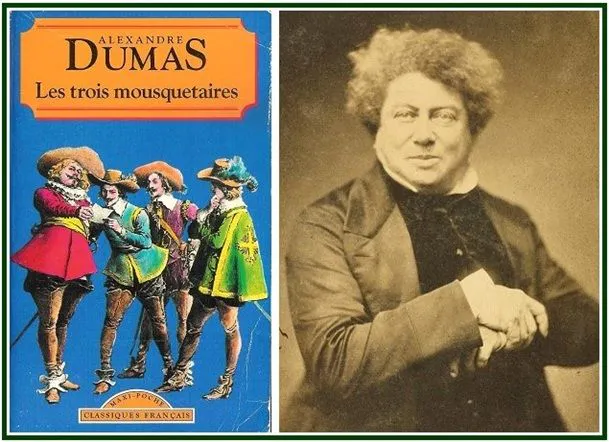
The Maxi-Poche Original Edition of “Les Trois
Mousquetaires”, and Alexandre Dumas (1802-1870)
* In his series of novels about the Musketeers, Alexandre Dumas stands for traditional ethics. He does so in a broad, intelligent way, through narratives calculated to elevate the lives of readers. Dumas accepts human contradictions as basic facts and takes practical spiritual lessons from human imperfections, which he often describes with a compassionate sense of humor.
* “The Three Musketeers”, “Twenty Years After” and “The Vicomte of Bragelonne” make a vast, fascinating description of a struggle: the battle between the old moral values of the medieval society – let us think of the Templars for instance – and the new absence of ethics, in the money-centered society of modern centuries, whose theology of egotism was established up to a large extent by the Jesuits.
* While facing modern hypocrisy, Dumas moderately defends the old Code of Honor and ethics of the cavaliers; however, he is not necessarily a conservative, and does not defend the social order of the Middle Ages as such. The boundless compassion he has been sharing since the 1840s with his readers around the world promotes social solidarity and mutual help.
* Paradox is part of life. Just as Helena Blavatsky, Dumas was a friend of Giuseppe Garibaldi, and a true friend of peace. According to Dumas, war and violence are unfortunate actions. Blavatsky thought the same. Yet there is no easy way to avoid wars, or spiritual ignorance.
* The long-standing struggle between traditional ethics and modern selfishness permeates Dumas’ novels. The fight between inner spiritual honor and outward egotistic comfort occurs fundamentally within individual human mind. Secondarily, it makes noise in the drama of external karmic effects. Human soul and human society are one.
* In the following paragraphs we translate and comment philosophical sentences selected from “The Three Musketeers” and its sequel “Twenty Years After”.[1]
From ‘The Three Musketeers’
* Let us not confuse prudence with cowardice; prudence is a virtue. (Maxi-Poche, p. 260)
By training his discernment the pilgrim will be able to see the difference between the two.
* [A certain King], like all weak hearts, lacked generosity. (Maxi-Poche, p. 686)
In other words, moral weakness provokes a lack of generosity. At the same time, moral courage is usually associated with a generous purpose.
* A gentleman possesses nothing except his word. (Maxi-Poche, p. 269)
Sincerity to one’s fellow creature emerges from honesty to oneself. Truthfulness is like the Sun: it sends its light in every direction inevitably. However, discernment is unavoidable: actions speak louder than words, and silence is often wise.
* As I am not a gentleman, I am free to lie. (Maxi-Poche, p. 275)
This comes from a historical novel set in the seventeenth century. Since the twentieth century, nobility is not a social convention any longer. It is now an attribute of the soul and only visible to those who have the eyes to see.
Moral nobility is more important than social status. On the other hand, a rascal can only see appearances and therefore concentrates his efforts on deceit. The first step of the fool in preparing his own karmic punishment consists in believing he is quite clever – and more intelligent than others.
* Behind each form of happiness in the present, a future fear is hidden. (Maxi-Poche, p. 427)
An important tenet in esoteric philosophy. “The Voice of the Silence” says: “… Thy Soul will find the blossoms of life, but under every flower a serpent coiled”.[2]
* Time brings opportunity; opportunity is the lottery or gambling system of a man: the more you commit yourself to your goal, the more you gain, if you know how to wait. (Maxi-Poche, p. 463)
Being able to wait for a long unforeseeable amount of time is as important as acting with the speed of a lightening. Total patience allows you to have unlimited intensity.
* An excessive worry can only be fought by extreme indifference. (Maxi-Poche, p. 442)
There are times when humbleness, detachment and indifference to non-essential factors help the pilgrim avoid anxiety over outward events.
From ‘Twenty Years After’
* Pythagoras made his disciples keep silent for five years to teach them to be quiet. (Éditions Robert Laffont, p. 598)
Silence makes it easier to listen to your conscience and spiritual soul.
* A good deed is never lost. (Éd. Robert Laffont, p. 618)
Everything is part of karma: even each thought has practical results. During situations when it is impossible to perform a correct outward action, honest good intention produces good karma according to its intensity.
* Blood calls for blood. (Éd. Robert Laffont, p. 674)
One act of violence stimulates another, and one military conflict leads to another, until the karmic reaction of respect for life emerges and harmony is restored. There are vast chains of actions that aim at creating conflict and provoking pain, while other chains of causation produce justice, equilibrium, inner learning, a stability of the soul, contentment and peace. One must choose the right one, and act in accordance with it.
* There is nothing more convincing than a great conviction; even skeptical people are influenced by it. (Éd. Robert Laffont, p. 690)
Actions and ideas are spread by example, and through the natural power of their living magnetism. But there is a time to sow and a different time to harvest.
* A habit of twelve or fifteen years has become second nature. (Éd. Robert Laffont, p. 703)
However, if you have an old habit that is an obstacle to your spiritual learning, remember one thing well: no one is ever too old to correct his limitations. Laziness can always be defeated by calm persevering action, and by an intense determination to correct oneself. Pythagorean tradition recommends: “do that which is right, and in time it will become pleasant for you.”
* It is part of human nature to seek perfection in pastries as in other things. (Éd. Robert Laffont, pp. 712-713)
Yet do not waste your energy in trifles, for some things are important, and others are not. Absolute perfection is not easy to attain, but everything can make some progress in the right direction. Improve yourself in the first place, and the whole world will get better in time.
* Sleep is a very capricious divinity, and it is precisely when we invoke it that it makes us wait. (Éd. Robert Laffont, pp. 719)
There is something sacred about the transition to sleep. An invisible door is passed and new dimensions open before you according to the present state of your soul.
* I see ingratitude not as a fault or a crime, but as a vice, which is much worse. (Éd. Robert Laffont, p. 729)
The feeling of gratitude means that our soul is alive. Reciprocity is part of the Law of Symmetry that regulates life.
* The appearance of external objects is a mysterious conductor, which corresponds to the fibers of memory and will sometimes awaken them in spite of us; once this thread is awakened, like that of Ariadne, it leads into a labyrinth of thoughts where we get lost following that shadow of the past that we call memory. (Éd Robert Laffont, pp. 811-812)
And the past must be cherished, for it is an unlimited source of helpful lessons for the present and inspiration for the future.
* [A son says to his father:] Your heart is so generous that you understood everything that was happening in mine. (Éd. Robert Laffont, p. 813)
Affinity makes feelings and thoughts transparent. A selfless view of life does not want and does not need to distort facts. By understanding the law of unity of all that exists, one can look at facts without the lens offered by egotism.
* It is with small armies that we win big battles. (Éd. Robert Laffont, p. 849)
Large corporations usually have no soul, or cannot listen to it. Complex bureaucracies are often unintelligent. A few good-willing people make the difference. Therefore Moses Maimonides wrote: “When I have a difficult subject before me – when I find the road narrow, and can see no other way of teaching a well-established truth except by pleasing one intelligent man and displeasing ten thousand fools – I prefer to address myself to the one man, and take no notice whatever of the condemnation of the multitude.” [3] Wisdom emerges from calm independent thought, not from large scale propaganda.
* Regarding one’s superiors, and especially when one’s superiors are princes, the supreme politeness is to obey without delay and without reasoning. (Éd. Robert Laffont, pp. 849-850)
If you happen to interact with someone who is wiser than you and is doing good, seize this privilege. Help such a person whole-heartedly, with no cavil or delay. Follow your conscience Try to learn true wisdom from him and from everything in life.
NOTES:
[1] The Three Musketeers: “Les Trois Mousquetaires”, Maxi-Poche Classiques, Maxi-Livres, 1997, 696 pages. Copyright 1994, Bookking International Paris. Twenty Years After: “Vingt Ans Après”, in “Les Trois Mousquetaires, Vingt Ans Après”, Les Grands Romans d’Alexandre Dumas, Éditions Robert Laffont, S.A., Paris, 1991, edited and annotated by Claude Schopp, 1388 pages. See also the second sequel to “The Three Musketeers”, “Le Vicomte de Bragelonne”, en cinq volumes, Paris, Nelson Éditeurs, 1955.
[2] This refers to the Hall of Learning. See “The Voice of the Silence”, by Helena P. Blavatsky (Ed.), Fragment I, page 6. On the severe karmic balance between happiness and suffering, read the article “The Law of Symmetry”.
[3] “The Guide for the Perplexed”, Moses Maimonides, Dover Publications, Inc., New York, 414 pp., see “Introduction”, p. 9.
The article “Thoughts Along the Road – 102” was published on the websites of the Independent Lodge of Theosophists on 23 November 2026. An initial version of it is part of the January 2024 edition of “The Aquarian Theosophist”, pp. 14-17.
Explore the full collection of articles entitled “Thoughts Along the Road”.
Read more:
* Alexandre Dumas and Social Conflicts.
* Alexandre Dumas Describes Cagliostro.
* The Mystery of Alessandro Cagliostro.
* Immortal Sages Humbly Obey the Law.
* Visit the channel of The Aquarian Theosophist on YouTube.
Subscribe to receive updates in your email:
By subscribing, you accept our Privacy Policy.